In 2021, Bily asked brands to reconsider long chains of tags and handoffs. The practical question still matters: can your team trace a reported conversion back to the customer action and explain every step?
The market has since moved toward first-party delivery. Google tag gateway is one sign of that change. The important lesson is not that a new feature settles an old argument. It is that measurement is moving closer to the brand, and ownership of the signal path is becoming part of normal operating practice.
Inspect the path behind the tag
Google Tag Manager made tag deployment accessible to many teams. Google Tag Gateway solves a different problem: moving the Google tag onto a first-party path. The setup works best when that path follows a clear event model.
A tag can fire successfully while carrying the wrong value. Two tags can report the same purchase. A browser event can disagree with the order record. More tools can create more data without creating more confidence.
Our original slogan challenged that pattern. We believed the brand should be able to follow a signal from the customer action, through validation and identity, to the destination that uses it. Every handoff should have a reason, and every reported outcome should reconcile with the business record.
What the Google outreach actually showed
On April 10, 2025, a Strategic Partnerships Lead at Google Ads contacted Bily. The message asked to learn more about how we implement first-party measurement and requested the right contact for an NDA before a call.
That outreach mattered because it showed the subject was worth a direct conversation. It did not, by itself, prove an endorsement, a formal partnership, or that Bily influenced Google’s product direction. Those would be larger claims than the evidence supports.
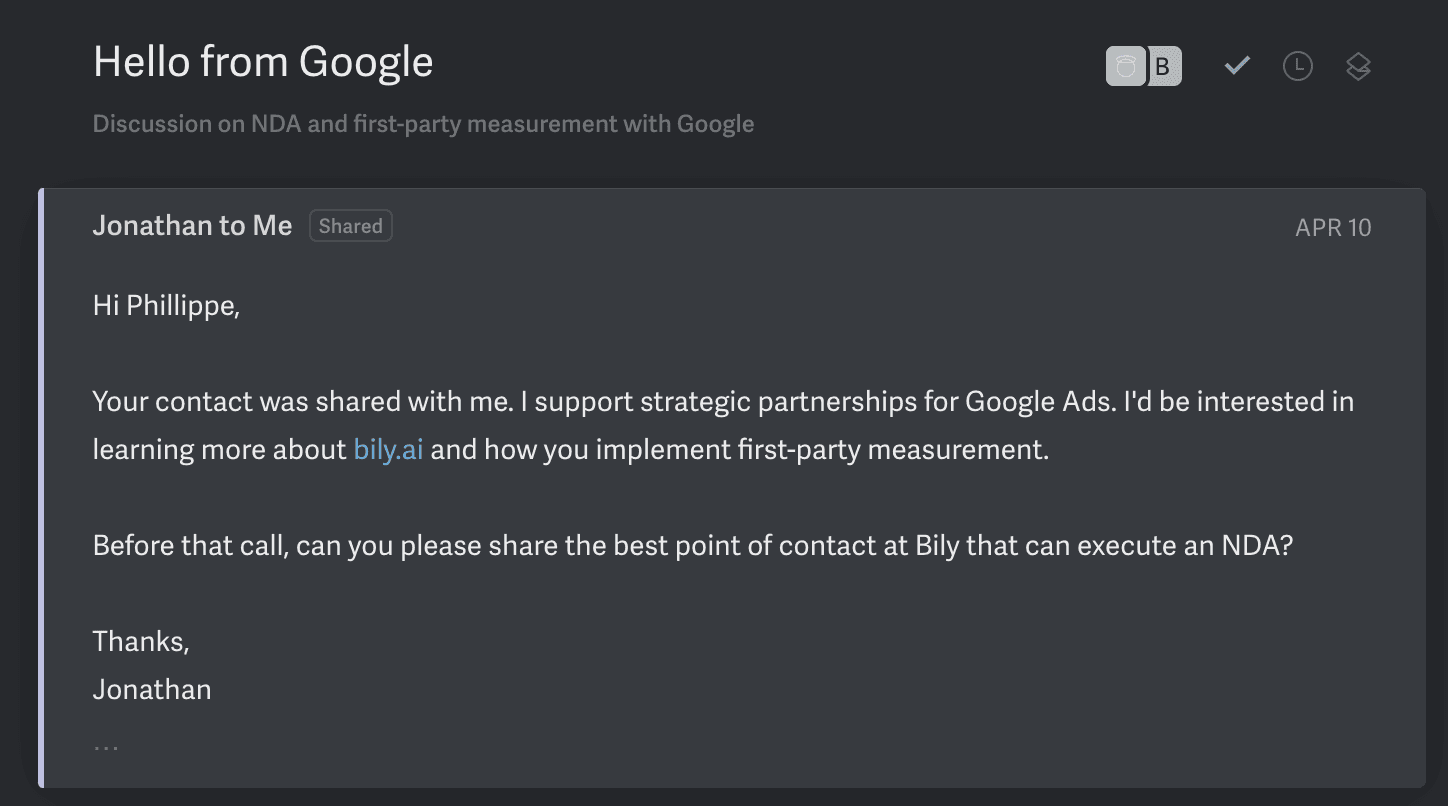
The screenshot is useful for a simpler reason: it records the moment accurately. Google was interested in comparing notes on first-party measurement. For a company that had spent years arguing for more direct ownership, that was meaningful without needing to turn it into a victory story.
What Google’s gateway changes
On May 8, 2025, Google made Google tag gateway for advertisers available to everyone. Google’s developer documentation describes it as a way to serve scripts and send measurement in a first-party context.
The direction can reduce some avoidable external handoffs and give teams a clearer boundary around how collection is served. But first-party delivery is not the same as first-party truth. A request coming from the brand’s domain can still contain a duplicate event, an incorrect value, or an identity that should not be used. Changing the route does not resolve the meaning of the data.
Teams often treat deployment as completion. They install a tag, see activity in a dashboard, and move on. Reliable measurement requires another layer of work: define the event, validate its context, reconcile it with the order, and monitor the path over time.
Own, verify, then act
Own the measurement relationship by keeping collection close to the customer journey and maintaining clear consent boundaries. Verify the evidence by resolving duplicates, preserving source and time, and reconciling conversions with commercial outcomes. Act only after the team can explain what the number represents.
This method is independent of any single platform. Google, Meta, TikTok, and analytics tools can each receive the context they need while the business maintains a consistent definition of the event. Platform reporting remains useful, but it becomes one interpretation of a journey the brand can inspect.
Bily was built around this operating model. Customers should not need to understand the underlying machinery, but their teams should be able to ask why a conversion was counted and receive a coherent answer.
The lesson is larger than one tool
The market did not need to abandon Google Tag Manager for the bigger idea to become clear: brands should own their signal path and be able to explain the result.
Start with one purchase. Check where its data is collected, validated, and delivered; confirm the value and remove duplicates. A first-party route is useful when the evidence arriving through it is reliable.